
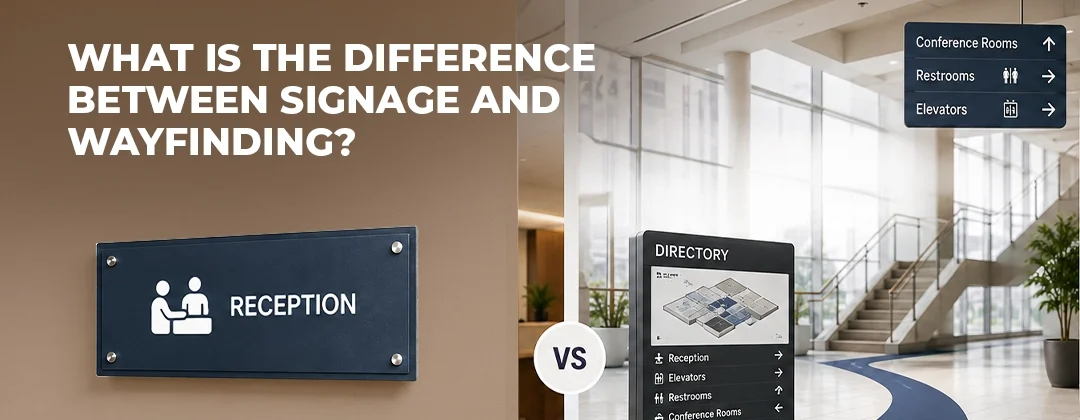
What Is the Difference Between Signage and Wayfinding?
If you have ever walked into a large building and instantly knew where to go, that was not an accident. It was the result of well-planned signage and wayfinding working together. But what exactly is the difference between signage and wayfinding? Many business owners in Doha use these terms interchangeably, but they are not the same thing. Understanding the distinction helps you invest in the right solutions for your space and your customers.
What Is Signage?
Signage is the broader term. It refers to any visual display used to communicate a message to an audience. Signage covers everything from a shop’s exterior fascia board to promotional banners, safety notices, branding panels, and digital displays. The primary purposes of signage are:
- Brand identity: Communicating who you are and what your business offers.
- Promotion: Advertising products, services, or events.
- Information: Sharing rules, hours, pricing, or safety instructions.
- Compliance: Meeting legal requirements such as fire exit signs or bilingual Arabic-English notices in Qatar.
Signage is everywhere. Every LED sign board, neon sign, acrylic sign board, billboard, and backlit display is a form of signage.
What Is Wayfinding?
Wayfinding is a specific category within signage. It refers to the systems of information — signs, maps, symbols, and cues — that help people navigate from one place to another within a space. Wayfinding is not about branding or promotion. Its sole purpose is orientation and navigation.
A complete wayfinding system typically includes:
- Identification signs: Telling you what a space is (e.g. “Radiology Department”).
- Directional signs: Pointing you towards your destination (e.g. “Exit →”).
- Informational signs: Providing context (e.g. floor directories or maps).
- Regulatory signs: Instructing behaviour (e.g. “No Entry”, “Staff Only”).
You will find wayfinding systems in hospitals, universities, malls, airports, hotels, government buildings, and large office complexes across Doha and Qatar.
Key Differences: Signage vs Wayfinding
| Aspect | Signage | Wayfinding |
|---|---|---|
| Primary Purpose | Communicate, brand, promote | Navigate and orient |
| Scope | Broad — includes all visual displays | Narrow — navigation-specific |
| Examples | Fascia signs, billboards, neon signs | Directional arrows, floor maps, room IDs |
| Audience Goal | Awareness and action | Confidence and clarity |
| Location | Indoor and outdoor | Primarily within a facility |
How Signage and Wayfinding Work Together
In practice, signage and wayfinding are complementary. A hospital, for example, needs bold exterior signage to establish its identity and attract attention. Inside, it needs a clear wayfinding system so patients, visitors, and staff can navigate efficiently without confusion or anxiety.
The best commercial environments in Doha — from The Pearl Qatar to major hospitals in West Bay — combine both seamlessly. The exterior grabs attention through strong outdoor signage and 3D sign boards. Inside, a coherent indoor signage and wayfinding system takes over to guide every visitor to their destination.
Why This Distinction Matters for Your Business
If you are planning a signage project for your facility in Doha, understanding this distinction helps you plan more effectively and budget more accurately. You may need:
- A pylon sign or exterior fascia for brand visibility from the road.
- An internal wayfinding system to guide visitors once they are inside your building.
- Bilingual Arabic-English versions of both, as required under Qatar’s signage regulations.
Speedline Media & Advertising delivers both. From exterior branding to complete internal wayfinding systems, we design, manufacture, and install signage solutions for businesses of all sizes across Doha and Qatar.
Speedline Media & Advertising
📍 Al Jazeera Street, Bin Mahmoud, Doha, Qatar
