
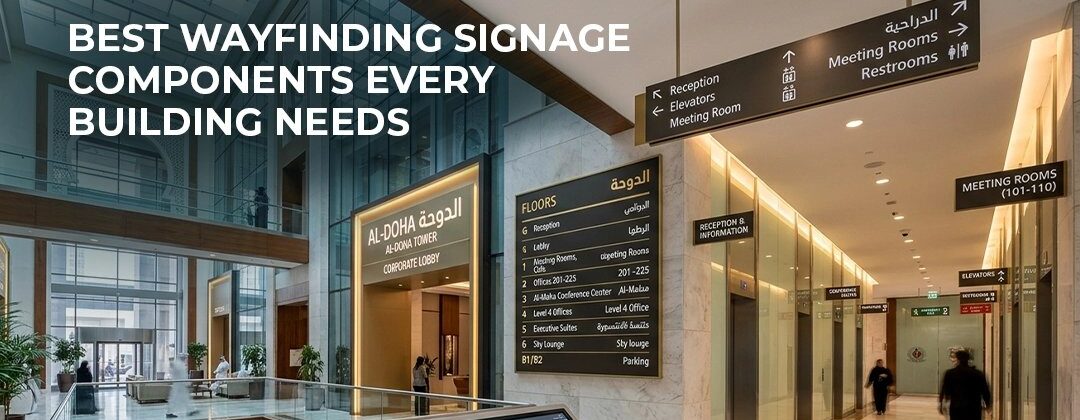
Best Wayfinding Signage Components Every Building Needs
A wayfinding system is not a single sign. It is a carefully coordinated family of components that work together to guide every visitor through your facility with confidence and ease. Whether you are designing a wayfinding system for a hospital, a corporate tower, a mall, or a university in Doha, these are the core components every effective system must include.
1. Entry and Arrival Signs
The wayfinding experience begins before a visitor enters your building. Entry signs establish identity and set the tone for the navigation journey ahead. They include:
- Building identification signs at the main entrance
- Car park entrance and exit signs
- Pedestrian approach directional signs from nearby roads or transport links
- Pylon and totem signs visible from a distance along major roads
These signs must be clearly visible, weatherproof, and — in Qatar — bilingual in Arabic and English. Our outdoor signage solutions are engineered specifically for Qatar’s extreme climate.
2. Building and Floor Directories
Directory signs provide an overview of the entire facility or floor, allowing visitors to plan their route before they start moving. They are most commonly located at main entrances, reception areas, and lift lobbies.
An effective directory includes:
- A clear, organised list of all destinations with floor or zone references
- A floor plan or schematic showing the overall layout
- A “you-are-here” marker indicating the visitor’s current location
- Emergency exit locations clearly highlighted
3. Directional Signs
Directional signs are the backbone of any wayfinding system. They guide visitors along the correct route at every decision point — junctions, corridor intersections, and level changes. Key principles for effective directional signs:
- Place signs before decision points, not only at them
- Group destinations by direction on each panel
- Limit the number of destinations per sign to five to seven maximum
- Use consistent, unambiguous arrow conventions throughout
Directional signs should be mounted at a height visible to all users, including people in wheelchairs. Acrylic sign boards and backlit panels are popular choices for indoor directional signage in Doha due to their clean appearance and high legibility.
4. Identification Signs
Identification signs confirm that a visitor has arrived at the correct destination. They are placed at the entrance to every named space — rooms, departments, offices, amenities, and facilities. Every identification sign should include:
- The room or space name in both Arabic and English
- A room number or code where applicable
- A relevant pictogram (e.g. toilet symbol, medical cross, reception desk icon)
- Braille text for accessible facilities, where required
3D sign boards create a premium, professional finish for identification signs in corporate offices, hotels, and luxury retail environments across Qatar.
5. Informational Signs
Informational signs provide context and detail that visitors need but that cannot be communicated through direction or identification alone. Examples include:
- Operating hours for departments or facilities
- Rules and regulations (no photography, no food, dress code)
- Emergency procedures and evacuation routes
- Patient or visitor instructions in healthcare environments
6. Regulatory and Safety Signs
Regulatory signs are not optional. In Qatar, certain safety signage is legally mandated and must comply with Civil Defence and municipal regulations. This includes:
- Fire exit and emergency evacuation signs
- Fire extinguisher location markers
- Prohibition signs (no smoking, no entry)
- Hazard warning signs in applicable areas
Speedline Media ensures all regulatory signage meets Qatar’s Civil Defence and Baladiya compliance requirements. Explore our indoor signage solutions for compliant, professionally produced safety signs.
7. Digital and Interactive Wayfinding
For large or complex facilities, digital wayfinding components add a powerful layer of flexibility and engagement. Options include:
- LED digital displays: Dynamic content that can be updated in real time to reflect changing room assignments, events, or announcements.
- Interactive kiosk directories: Touchscreen maps that allow visitors to search for specific destinations and generate turn-by-turn directions.
- QR-code enhanced signs: Physical signs with QR codes that open a digital map on the visitor’s smartphone.
8. Accessible Wayfinding Components
An inclusive wayfinding system serves all users, including people with visual impairments, hearing impairments, and mobility challenges. Accessible components include:
- Braille and tactile text on identification signs
- High-contrast colour combinations meeting accessibility standards
- Tactile ground surface indicators guiding visually impaired visitors
- Sign mounting heights accessible to wheelchair users
- Audio wayfinding systems in high-footfall public spaces
In Qatar, accessibility requirements for people of determination are regulated and must be incorporated into any signage system serving the public. Contact Speedline Media to discuss compliant, fully accessible sign board solutions in Qatar.
Speedline Media & Advertising
📍 Al Jazeera Street, Bin Mahmoud, Doha, Qatar
