
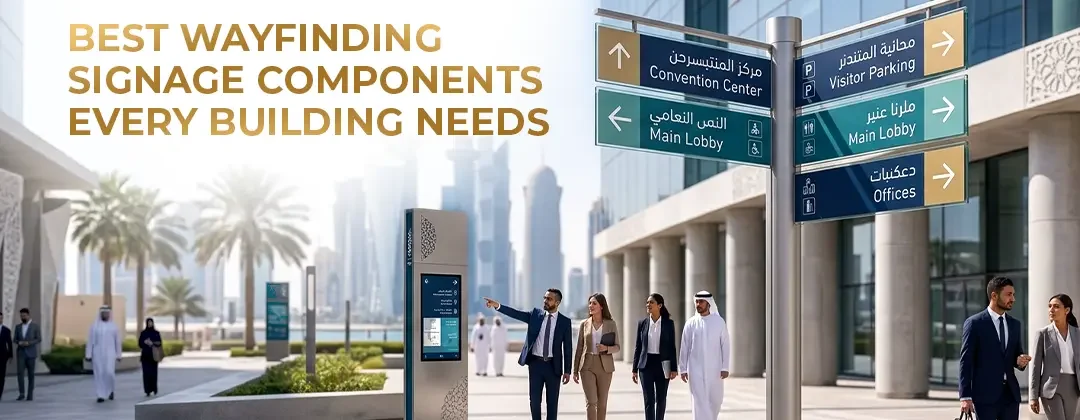
Guidelines for Wayfinding Signage Design in Qatar
Effective wayfinding signage does not happen by accident. It is the result of disciplined design thinking, a deep understanding of human behaviour, and adherence to proven guidelines developed by wayfinding professionals worldwide. Whether you are designing a system for a hospital, a government building, a hotel, or a corporate campus in Doha, these guidelines will help you build a wayfinding system that genuinely works.
Guideline 1: Design for the First-Time Visitor
Every design decision should be made from the perspective of someone entering your building for the first time, with no prior knowledge of the layout. Staff and regular visitors develop familiarity that blinds them to navigation problems. Your wayfinding system must serve the uninitiated — because that is who needs it most.
Test your designs regularly with first-time visitors, and treat their navigation errors as design feedback rather than user error.
Guideline 2: Establish a Clear Hierarchy of Destinations
Not all destinations in a facility are equally important. An emergency exit is more critical than a vending machine. A main reception is more important than a storage room. Your wayfinding system must reflect this hierarchy through:
- Sign size — more important destinations appear on larger, more prominent signs
- Typography weight — primary destinations in bold or larger type
- Sign placement — primary signs at the most visible locations
- Colour — primary destinations distinguished by colour from secondary information
Guideline 3: Place Signs at Every Decision Point
A decision point is any location where a visitor must choose their direction. This includes corridor junctions, lift lobbies, staircases, and building entrances. Every decision point must have a sign — without exception. Missing a single sign forces visitors to guess, and a wrong guess destroys confidence in the entire system.
Additionally, place advance directional signs before major decision points — particularly for complex routes that require several turns. Our indoor signage solutions are designed to cover every decision point comprehensively.
Guideline 4: Use a Consistent Visual System
Consistency is non-negotiable. Every sign in your system must share the same visual DNA — the same typeface, the same colour palette, the same arrow style, the same icon set, the same layout grid. When visitors encounter a consistent system, they quickly learn to trust and read it. Inconsistency erodes trust immediately.
Document your visual system in a wayfinding design standards manual before fabrication begins. This ensures consistency across all signs, all suppliers, and all future additions to the system. Speedline Media can produce your complete system to a unified standard — from acrylic sign boards to 3D sign boards and backlit panels.
Guideline 5: Prioritise Legibility Over Aesthetics
Wayfinding signs must be read quickly, at a distance, and often under stress. This is not the context for decorative typography, low-contrast colour combinations, or complex layouts. The guidelines for legibility:
- Use clean, sans-serif typefaces (Arial, Helvetica, Frutiger, or similar)
- Minimum text height: 25mm for every 10 metres of reading distance
- Minimum contrast ratio: 4.5:1 between text and background (WCAG standard)
- Avoid all-caps text for long destination names — mixed case is faster to read
- Use sentence case or title case, not all-capitals
- Left-align text for Western-language content; right-align for Arabic
Guideline 6: Comply With Qatar’s Bilingual Requirements
In Qatar, all commercial and public signage must include both Arabic and English text. For wayfinding signs, the Arabic text must be accurate and professionally typeset — not machine-translated or poorly formatted. The layout should present both languages with equal clarity, respecting the right-to-left reading direction of Arabic.
Speedline Media employs certified Arabic typographers for all bilingual wayfinding projects, ensuring both languages communicate with equal authority and professionalism across all sign board types.
Guideline 7: Design for Accessibility
A wayfinding system that serves only the able-bodied is an incomplete system. Qatar’s regulations for people of determination require accessible design in all public and commercial facilities. Accessibility guidelines for wayfinding include:
- Identification signs with Braille and tactile text where required
- Sign mounting heights that serve wheelchair users (typically 1.0m to 1.7m centreline height)
- Tactile floor guidance systems at key navigation nodes
- High-contrast colour combinations accessible to people with colour vision deficiency
- Avoidance of red-green combinations as the sole differentiator between zones
Guideline 8: Integrate Outdoor and Indoor Wayfinding
The wayfinding journey begins before a visitor enters your building — from the moment they approach from the road, car park, or public transport. The transition from outdoor to indoor must be seamless. A visitor who followed a clear pylon sign from the main road should encounter a coherent continuation of the same visual system at the building entrance and throughout the interior.
Speedline Media designs and installs both outdoor signage and indoor signage as an integrated system, ensuring visual consistency from kerb to destination.
Guideline 9: Obtain All Required Permits
In Qatar, wayfinding and signage installation requires Baladiya approval before any sign is mounted. Illuminated signs require additional Civil Defence sign-off. Work with a licensed signage contractor who manages the permit process on your behalf — avoiding delays, non-compliance fines, and the cost of replacement signs.
Speedline Media handles all municipal and Civil Defence permit applications for our signage clients across Doha and Qatar as a standard part of our service. Explore our billboard and hoarding services and complete neon sign board solutions for all project types.
Speedline Media & Advertising
📍 Al Jazeera Street, Bin Mahmoud, Doha, Qatar
